

This article was cross-published by David Ganske on LinkedIn. You can access it directly here.
Whenever anyone starts thinking about earning media coverage, the highest bar of success usually comes to mind. Maybe it’s “Let’s get an interview on CNN” or “Could we get the state senator at our event?” or “We would like a feature in The New York Times.”
In the early stages of communications planning, it’s important to have lofty goals. However, it is also important to understand what is actually achievable. This is especially true in clean energy and climate tech, where stories can be technical, timelines are long, and reporters field a steady stream of funding and project announcements.
The stage and scale of a company matters, too. It will be easier for a more established company with larger projects and reach to gain media coverage. While tactics do vary based on where a company is on its journey, there are still some general trends of what you can expect to achieve. If you are just getting started, I highly recommend that you also read my previous article on how to set your PR goals and build a media outreach program and check out our communications archetype quiz to see where you stand today.
Let’s start with a definition of earned media coverage. It essentially refers to any mentions or articles by a third party without any form of payment. In this way, they are “earned” and not paid or sponsored because the reporter or outlet sees value in telling your story.
Earned media coverage can result from a variety of paths, such as formal press releases, story pitching, events, opinion articles, and more. This article looks at some of the common options to gain earned media coverage, provides some pitching recommendations, and sets expectations, so you can take the right next step toward a more impactful communications strategy.
Earned media options
Press releases
A press release is a formal statement that notifies media outlets of news that a company has publicly announced. It is authored entirely by the company and often sent “over the wire” — a news feed of similar announcements that journalists and other media professionals can pull from. Examples include PR Newswire and GlobeNewswire. Press releases should be used sparingly and only for major news unless you have special requirements like those that exist for publicly traded companies.
Today, press releases blasted out over the wire aren’t typically the best option for gaining direct traction with media outlets. There has actually been ongoing debate within the PR industry for years about whether the press release is dead.
That said, it doesn’t mean they are not worth doing. They create a helpful public record of your company’s activities and can add credibility, especially for early-stage companies. Press releases can also help with search engine optimization (SEO) and generative engine optimization (GEO), providing a route to show up in answers and search results.
To successfully earn media placement, however, a press release almost always needs to go out with an accompanying story pitch targeted to specific journalists. This involves targeted outreach to media outlets and reporters that are a good fit — preferably under “embargo” at least one to two weeks ahead of the actual announcement. This is usually how a press release turns into timely coverage, because the reporter knows the story exists ahead of time. Otherwise, it is relatively unlikely that they stumble upon the announcement at the right time.
Events
Events can be a lot of work, but an in-person gathering is a great way to create extra buzz around a major announcement. When done strategically, events can provide local and regional press with the visuals they need to make a story viable — think TV segments on the nightly news or radio interviews with your local station.
Reporters that attend your event will take advantage of the opportunity to get photos and comments from relevant stakeholders on the spot. Groundbreaking ceremonies, ribbon cuttings, seminars, and conferences all fall into this category.
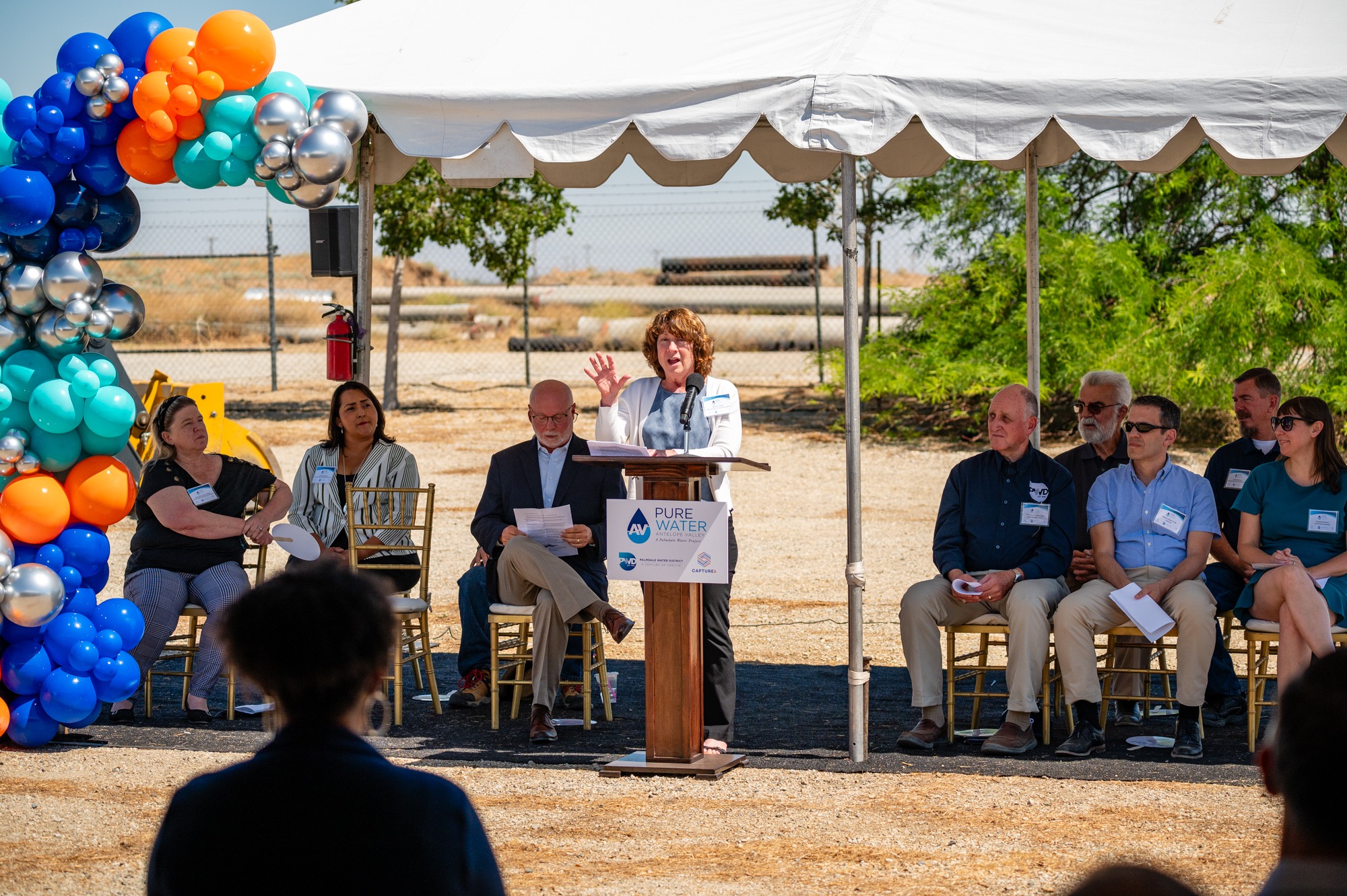
Above: Nancy Vogel, Senior Policy Advisor of the California Department of Water Resources speaks at the Capture6 Project Monarch groundbreaking event in Palmdale, California, on June 20, 2024. The event successfully earned coverage in the Los Angeles Times, Fast Company, and other outlets.
Story pitching
A proactive story pitch is different from a press release. It takes something from inside your company, such as proprietary data, a project insight, or in-house expertise, and frames it as a story idea for a specific journalist. These pitches require careful research and targeting, and the best ones go beyond the company itself to participate in a broader conversation.
Some angles worth exploring:
- Is there a broader industry trend your work speaks to?
- Are there personal or human stories you can showcase?
- Do you have unique photography or video to share?
- Is there a larger challenge or problem you are solving that a general audience would recognize?
Story pitches can take a lot of effort and patience, but they are more likely to result in original, in-depth coverage than a syndication of a press release or an organic mention in a story about a related topic. They are also how you build real relationships with reporters over time and become a source they call when they need an expert in your space.
Opinion articles and bylines
Not every story needs a news hook. Opinion articles and bylined articles let your leaders share a point of view in their own words, which makes them one of the most reliable ways to build credibility when you don’t have a major announcement on the calendar.
The two are related but different. An opinion article, also known as an “op-ed”, runs in the opinion section of a newspaper or general news outlet and argues a clear position on a timely issue — permitting reform, a state clean energy mandate, or what a new federal policy means for your sector. A byline, or contributed article, typically runs in an industry publication and leans more educational, such as lessons learned from a first-of-a-kind project or practical guidance for buyers in your market.
Once published, a strong opinion piece keeps working for you. You can share it on LinkedIn, repurpose it for newsletters, and reference it in future pitches. It also helps position your executives as thought leaders for reporters to call when your topic is in the news.
Setting expectations
So what is realistic for a company announcement or event? The honest answer is that it depends on how newsworthy the story actually is, which in turn depends on how unique, timely, or significant it is for the intended audience.
To gut-check whether your announcement is newsworthy, ask yourself:
- Why is this story important outside of our company? Is it big? What does it say about our wider industry?
- Is the story timely? Why is it important right now? What is happening in the news that aligns with — or contradicts — the news we’re sharing?
- Why should target audiences care about this news?
- What challenge or problem is being addressed or solved? Why does this matter to your target audiences?
Some things that reliably make a story more newsworthy for earned media are significant dollar amounts attached to projects or investments (ideally millions of dollars or more), collaborations or partnerships with recognizable names like major corporations or government agencies (a U.S. Department of Energy grant or a partnership with a major utility, for example), genuinely novel technology that people can see and touch, a meaningful policy change, new proprietary data, or a strong geographic connection for a local or regional outlet. Some companies will naturally have more of these hooks than others — and that’s okay.
One important reminder is that what feels big to you may not feel big to a reporter. As hard as it can be, try to see your story through their eyes. They are pitching their editor, too. Give them something worth fighting for and the context around why it is important.
To set reasonable expectations for a given story, you can rate the newsworthiness of your announcement based on its uniqueness, timeliness, and scale. In the table below, “high-quality pickups” are a subset of total pickups: original stories with reporter interviews or added context, rather than brief mentions or reposted releases. Here’s a rough guideline of what you might be able to secure for earned media based on this methodology, bearing in mind that there is no such thing as “promised” or “guaranteed” earned media:
The other thing worth knowing is that local and regional reporters are often more likely to cover the smaller, incremental developments than national ones, especially early on. They respond faster, they show up to events, and they are genuinely looking for stories with geographic relevance. A well-placed story in a regional business journal can often do more for your credibility than a brief mention buried in a national roundup. Depending on your target audience, local coverage may also be the more strategic route.
How to increase your chances of coverage
Preparation and patience are key to getting mentions in a relevant outlet. Here are strategies that we’ve found consistently increase the likelihood of earned media coverage.
Pitch media early, under embargo
An embargo is a mutual agreement that gives reporters a heads-up on your announcement, affording them time to interview stakeholders, research context, and produce stories in advance of your news going public. Ever wonder how a press release gets published and an hour later there is press coverage, complete with original quotes and photos? At least some of that can be attributed to pitching under embargo. For big news items, aim to pitch at least one to two weeks in advance of your announcement date to help reporters prep their story.
Include real data
Effective messaging goes beyond value statements by including proof points. This matters enormously for journalists and readers as well. For investment announcements or project financing, this could be a dollar figure. For a project announcement or a new program, this could mean jobs created, solar panels installed, or the impact on a certain number of households. Reporters and their editors use data to understand the scale of a story. Leave figures out and many outlets simply will not cover the story. The bigger the better, too. While a $5 million raise may seem big to you, know that a reporter might also be hearing about a $50 million raise at the same time.
Tell a human story
Trade coverage is valuable, but if you want to reach regional newspapers, radio, or mainstream business outlets, you need people. Who built this? Who does it affect? A project that creates local jobs, a community getting reliable power for the first time, or a founder with an unlikely path are great angles to take a B2B story and make it readable for a general audience.
Have your assets ready
Reporters are busy, and their editors want visual content. High-quality photos of your team, technology, or project site make your story more publishable. Even if you do not have a recent photo, renderings, leadership headshots, and product images all help. Come prepared.
Build a communications strategy that compounds
Media pitching works best when it is coordinated with your broader marketing and growth strategy. We always recommend starting with a strong communications foundation, complete with key messaging and a formalized internal workflow. When your messaging is sharp, your timing is intentional, and your team can tell the story clearly before it goes public, coverage becomes easier to earn.
If you are developing your communications strategy, our team at DG+ can help create a plan, ideate newsworthy stories, and pitch to relevant reporters. Contact us to find out how.
Read more news and insights from the DG+ team.
.png)



.png)
.avif)
Let’s talk about what you’re building.
Whether you’re refining your positioning, preparing for growth, or trying to make a complex product easier to understand, we’d love to hear more. Share a bit about your goals or challenges and we’ll get back to you with a clear, honest perspective on how we can help.
Skip the form and email us directly at hello@dgplusagency.com