

There's a lot of debate around the energy transition — what technologies to use, how and where to deploy them, which policies will support the fastest, most sustainable growth, and so on. But if you want to see what the rapid deployment of renewable energy looks like in practice, look no further than RE+.
With nearly 10,000 companies in attendance at this year’s conference — the largest in North America — RE+ drew in renewable energy professionals from around the world and showcased the clean energy transformation underway both in the United States and abroad.
For DG+, the conference was a welcome opportunity to take the temperature of a fast-moving industry two years after the historic investments of the Inflation Reduction Act (IRA) and to see where the sector — and the stories it's telling about the energy transition — are headed. Here's what we noticed:
Energy storage was everywhere
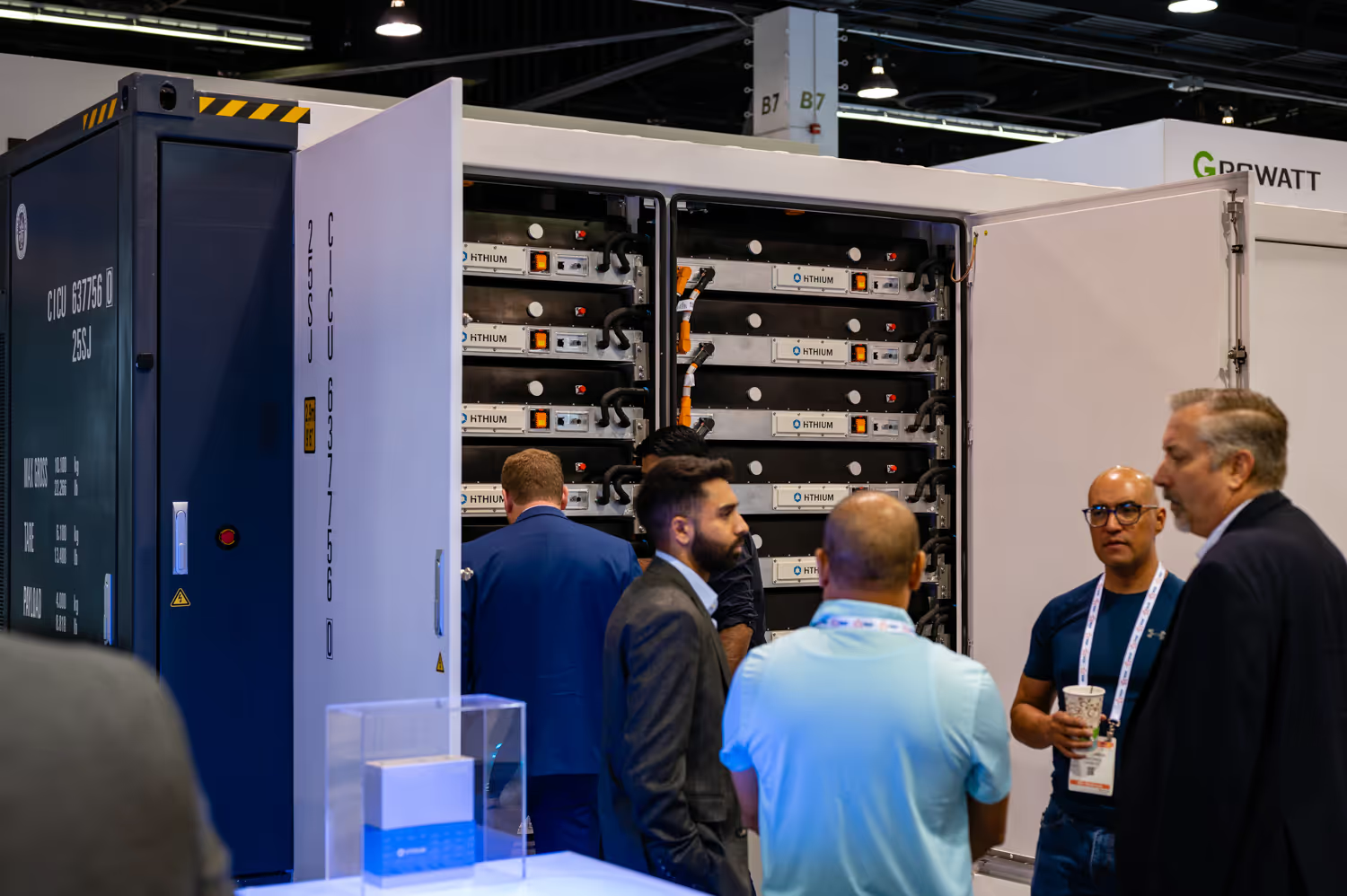
This was obvious upon entering the exhibit halls: Battery energy storage was absolutely everywhere. Whether you were curious about residential, commercial, or utility-scale, the sheer number of products was overwhelming.
Many traditional solar companies now have storage products, and foreign companies are quickly entering the U.S. market en masse to compete (especially from China). While there is certainly growth in this sector, the quantity of vendors does make me wonder how much consolidation will occur at some point in the future as the market matures. The photos below show some of the notable displays, including Canadian Solar and Hithium.

— David Ganske, CEO
Green hydrogen is on the rise
A relative newcomer to the RE+ conference continues to rise: green hydrogen. Now with added support from the IRA, more and more companies are entering the fray. Participants included developers, equipment providers, and heavy-duty truck manufacturers.
In the first image below, Matt McMonagle of NovoHydrogen and Paul Dainora of Ohmium discuss the roadmap for scaling up green hydrogen while lowering cost. This event was one of many on the program related to hydrogen development and growth in the coming years.


— David Ganske, CEO
Where was wind?
This being my first appearance at RE+, it was eye-opening to see how much the event was dominated by solar and energy storage, which was nearly omnipresent — almost to the point of stealing the show from solar. Given how the renewable energy market has coalesced around solar and storage over the last few years, it makes sense. Still, despite walking through almost every showroom, I can’t recall seeing a single booth or demonstration focused primarily on wind energy, which was surprising.
Wind energy isn’t going away anytime soon. Production has grown every year since 2018, and it’s still going up — earlier this year, the U.S. Energy Information Administration (EIA) predicted: “Wind power generation will grow 11% from 430 billion kilowatt-hours (kWh) in 2023 to 476 billion kWh in 2025.” But even a respectable 11% growth rate pales in comparison to solar’s ongoing proliferation. In the same article, EIA said it expects solar energy generation to “grow 75% from 163 billion kWh in 2023 to 286 billion kWh in 2025.” Meanwhile, energy storage generation tripled in 2023. At RE+, everyone is trying to scale the steepest growth curve.
— Daniel Jones, marketing and communications manager
It’s raining men

For someone who spent nearly a decade working in the male-dominated outdoor industry, I'm used to being one of the few women in the room. However, as one client observed to me (who was also attending her first RE+), “I’ve never seen so many khaki slacks in one place in my life.”
As of 2022, a staggering 70% of the U.S. workforce for wind and solar electricity generation was male — even worse than the gender gap in coal and gas power generation. And despite making up 46.8% of the U.S. workforce, women only hold 25 seats on the boards of the world’s 200 largest utilities. Additionally, a 2020 report from the Global Accelerator Learning Initiative found that 63% of energy-sector startups surveyed were led by all-male teams.
While it’s no secret the renewable energy industry is dominated by men, it was staggering to see it in person with 40,000 people under one roof. While there were talks at RE+ targeted towards women and allies who support the advancement of women and diversity in the clean energy industry, and organizations like Women of Renewable Industries and Sustainable Energy (WRISE) that are devoted to doing the work to bridge the gap, it was evident at this year’s conference that there’s still important work to be done here.
As the Center for American Progress put it, “increasing women’s participation in the clean energy economy will further America’s progress on climate action and improve women's economic security.” I think that’s something we can all get behind.
— Barbara Weber, marketing manager
Beautiful little models of big things
Gone are the days of just seeing solar modules around the RE+ exhibit floor. Booths are significantly more elaborate as companies are making big investments into marketing their new technology. The challenge is that many new products are simply way too big to feasibly fit in a typical booth. Moreover, many companies need to show how their products interact as part of a larger system, such as a microgrid or utility-scale battery storage at a substation.
To fix this problem in a cost-effective way, many companies had smaller models on display. These were not your average diorama, either. They were elaborate 3D-printed or custom-built models that would feel at home in an architectural studio. Examples include battery energy storage systems, green hydrogen electrolyzers, home energy backup systems, electric vehicle charging systems across parking lots, and many more.

— David Ganske, CEO
The solar coaster continues…
With the IRA now in its second year, government funding and tax incentives continue to have a notable impact on renewable energy industries. But uncertainty is still in the air, particularly with a federal election on the horizon, and industry folks are trying to gauge what their world will look like after Voting Day. What, if any, changes will there be to the IRA and its incentives? Would a Harris presidency build upon this legislation, or continue business as usual? How deeply would a Trump White House affect the business environment for clean energy companies? Will there be any additional progress on lingering issues like interconnection and permitting reform?
Clearly, the industry is hungry for thoughtful insight on the election. I attended a presentation of the latest Wood Mackenzie-SEIA solar market insight report where audience members practically jumped out of their chairs to snap a photo of the projected “extreme downside” scenario that would result from Republican officials — who have been largely unsupportive of clean energy development — taking control of both the White House and Congress. The prediction saw a 27% decrease in annual solar PV capacity additions but also pointed out that this scenario was highly unlikely.
Unfortunately, that’s where the presentation ended. I would have loved to hear more about other, more likely scenarios. But nuanced insight into post-election clean energy policy remains hard to find for good reason: No one actually knows what will happen. We can make some broad assumptions — most of the IRA is safe under a Democratic president, likely not so under a Republican one — but it’s really anyone’s guess until the ballots are counted.
— Dana Filek-Gibson, communications manager
…And the story stays the same
Walking around the RE+ expo halls, it was clear the marketers and PR professionals who brought it all to life knew their business-focused audience well, but a lot of folks appeared to be pulling from the same playbook. I saw a slew of messages promoting “trusted” solar partners and more banners advertising cleantech “solutions” than I could count. While these words accurately capture the way the industry sees itself, they aren’t helping anyone who wants to stand out in a sea of “solutions.” Finding new, unexpected ways to tell the clean energy story — and a company’s role in it — will allow businesses to break through the noise.
One more thing worth pointing out: On the flip side of all the standard industry messaging at RE+, I spotted just one reference to “climate action” in company displays. I’m sure there were a few more — I didn’t get to everything! — but generally speaking, the industry seems to shy away from talking about how the energy transition is tackling climate change. To me, this is a missed opportunity: While climate change can be a polarizing issue, it is possible to talk about environmental impact without diving head-first into the political minefield that climate change can conjure up.
Not everyone has to become a bleeding-heart climate campaigner, but renewables as an industry should not be afraid to be a little louder about the impact it can have — and the responsibility that everyone, including clean energy businesses, has in responsible, sustainable development. This industry is helping to build the infrastructure and economy of the future, and that work is not just about lowering emissions numbers on a spreadsheet — renewables are genuinely improving the lives of everyday people through access to good-paying jobs, affordable power, cleaner air, and more reliable energy. That’s something to celebrate, not shy away from.
— Dana Filek-Gibson, communications manager
Need help with your conference strategy? Download our 2024 cleantech events calendar or contact the DG+ team today to learn more about how we can help your business stand out.
Read more news and insights from the DG+ team.
.png)



.png)
.avif)
Let’s talk about what you’re building.
Whether you’re refining your positioning, preparing for growth, or trying to make a complex product easier to understand, we’d love to hear more. Share a bit about your goals or challenges and we’ll get back to you with a clear, honest perspective on how we can help.
Skip the form and email us directly at hello@dgplusagency.com