

This article was cross-published by David Ganske on LinkedIn. You can access it directly here.
Whether you are a business owner, nonprofit director, or an in-house marketing leader, there are always competing priorities and it can be hard to figure out what steps are necessary to grow a brand the right way.
You may have goals, such as more sales or more followers, but it can be daunting to understand how to get there. Should I invest in a new website? Should we spend our time posting to LinkedIn? What if I simply need to get a proposal out the door?
These are great ideas, but it is important to follow a tried and true order of operations for building a new brand. Otherwise, you risk wasting time and money having to rework things later. We see this pattern repeatedly with climate tech companies.
This is where analogies can be really handy. In this case, we think about it like building a new home.
Would you invite people over for dinner before you have furniture? Would you buy furniture before you have drywall and paint? Probably not.
Just like a new home, it’s important to start with a foundation and the core building blocks necessary before launching a marketing campaign or announcing a new product or service. When companies skip foundational work, they accumulate what we call foundation debt. Just like technical debt in software, it shows up later as confusing messaging, inconsistent sales materials, and websites that need constant rewrites.
This is what the “Foundation” stage of our Pre-Seed to Scale Roadmap sets out to do. It outlines the core marketing and communications activities that every clean energy and climate tech organization should do before launching.
Let’s now look at each of these activities to understand why they are so important at this stage.
Foundation stage activities
Audience segmentation
Your organization likely has a product or service that it hopes to sell — but to whom? Who are you trying to reach? Who has a problem that you are hoping to solve? Where are they located? What do they do? What pressures are they facing internally?
This is why audience segmentation is so important and why we start with it early at DG+. Without knowing who you want to purchase your product or services, it will be much harder to deliver other marketing and communications activities that move the needle.
Our process at DG+ begins by asking a lot of questions. We interview leadership, sales teams, and sometimes even customers.
For example, we often begin working with companies that are targeting a broad segment like “utilities.” It’s important to break this down into distinct audience segments like “grid operations leaders in PJM” or “utility innovation teams in PG&E”. Then, we can dive deeper into their pain points and needs.
Moreover, B2B companies often have a high-value product and a long sales cycle. As the product becomes more complex, there are often more and more stakeholders for a decision. It’s important to understand who each stakeholder is and what they care about. Otherwise, your messaging risks becoming diluted.
Competitor analysis
It’s usually pretty easy to think of organizations with competing products or services. Business leaders can often rattle off three to four pretty quickly. But competitor analysis goes deeper than that.
Have you looked closely at your competitors’ offerings, messaging, and strategy? What are they doing well or not? How can you differentiate yourself from them?
In climate tech especially, differentiation can be difficult because many companies describe themselves in similar ways: “accelerating the energy transition”, “enabling decarbonization”, “unlocking grid flexibility.” When everyone uses similar language and visual cues, it becomes difficult for buyers to clearly distinguish between solutions.
Even if you think you don’t have a direct competitor with the same exact product, there is always a competing choice. For early-stage companies with a new product or service, you still compete against the status quo (or simply inaction). There will be challenges getting internal champions, budget approvals, and overall acceptance.
Visual brand creation (i.e. logo and style)
When you ask anyone to build a brand, one of the first things that comes to mind is “what will it look like?” What kind of vibe or aesthetic it has can feel as important as the product or service itself.
Logos will stick around, so it’s important to take time. We start our process with a lot of questions to understand the nuances of your organization, curate inspiration, and find ways to differentiate visually from your competition.
The renewable energy space is awash with greens and blues and stock photography of storage units that say energy storage on the side. That just means there is more opportunity to stand out successfully by being different.
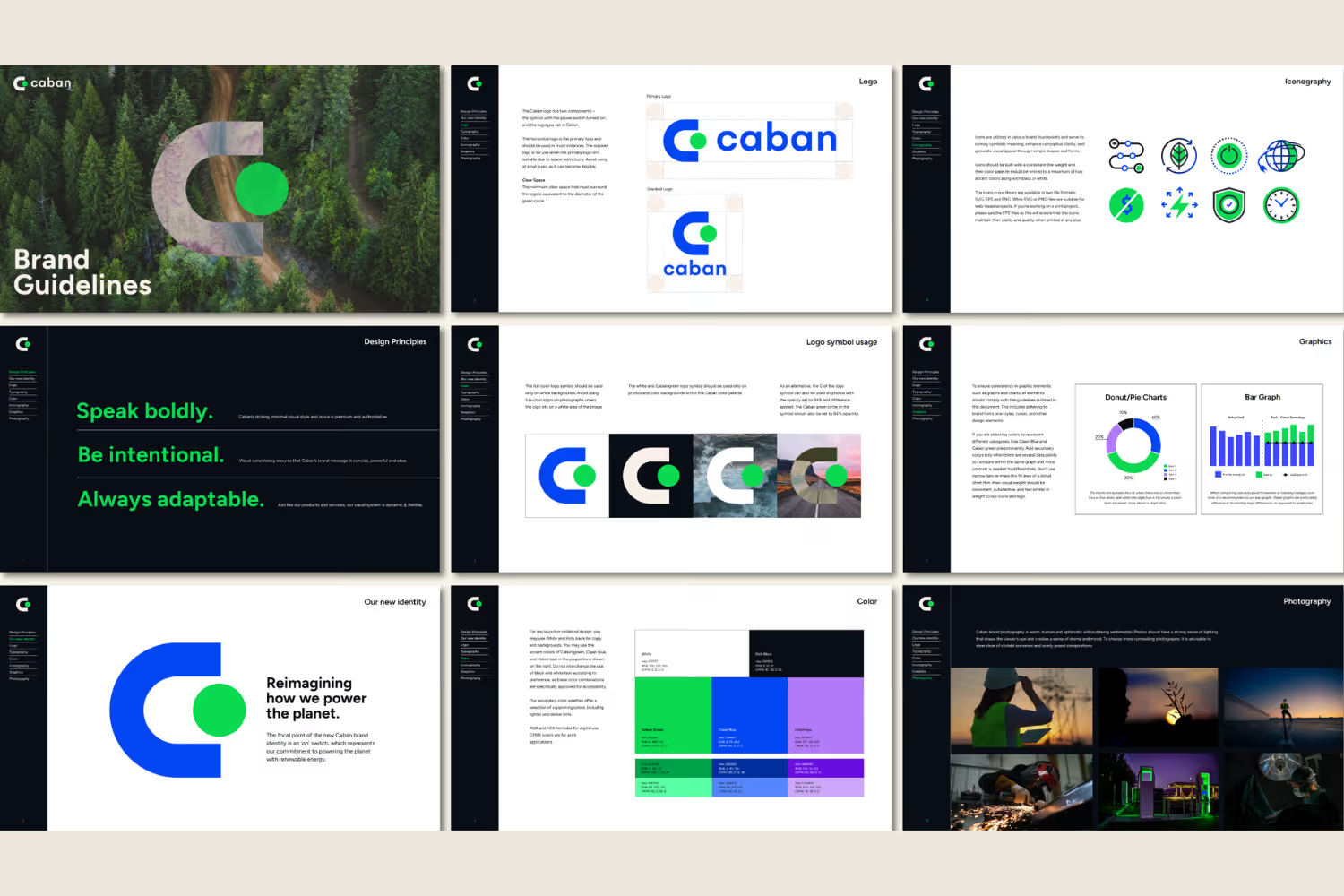
Just like key messaging provides the uniformity and consistency to convey what you do (more later), the visual brand does the same for your organization’s look and feel. Specific deliverables include variations of your logo, typography, color palette, image usage guidelines, iconography, and more, in a consolidated brand guidelines document.
Key messaging
Every time a team member creates content, they will need to write language that describes the organization’s purpose, values, products, services, and much more. These words represent the messaging that conveys the value that you provide.
Why does your organization exist? What problems do you solve? How are your products and services unique? Why should someone risk buying from you?
If no foundation for messaging exists, organizations can run into ineffective communication, failure to address audience’s needs, poor consistency, and wasted effort across the team.
The goal of this activity is to create a messaging database that is effective and available across the organization to approach varied audiences. This typically includes your mission, vision, positioning statements, messaging pillars (or value themes), proof points, and guidelines on tone.
Website design and development
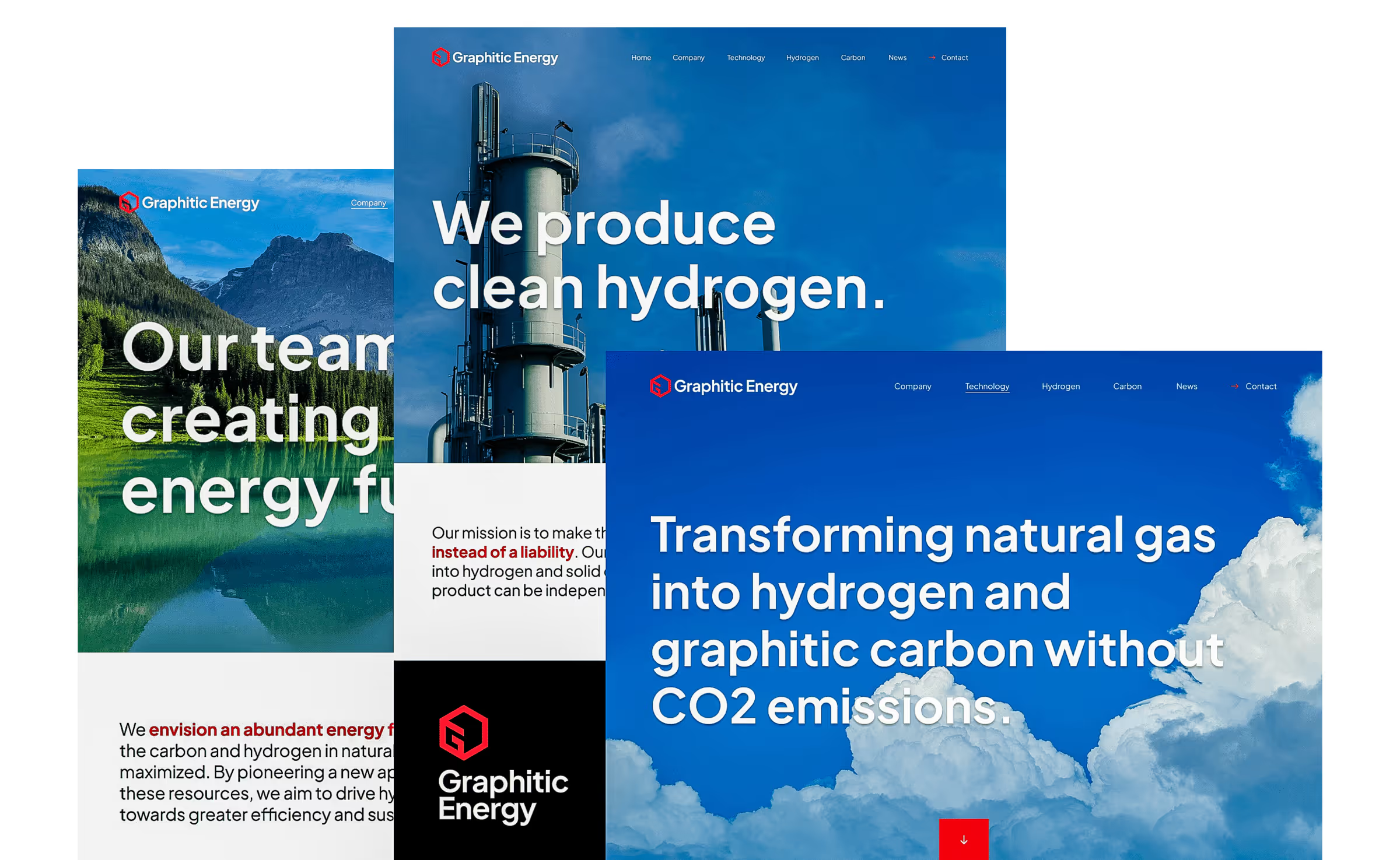
Your website is often the first meaningful interaction someone has with your company. In many cases, its appearance determines whether they reach out or move on.
For early-stage companies, a clear, focused website with just a few pages can outperform a bloated site with many unfocused pages.
Clarity of positioning, intuitive navigation, and strong calls to action matter more than flashy features. When messaging and segmentation are clear, websites convert better because they speak directly to the right audience.
Think of your website as how you would put yourself together for a first meeting. Would you want to be polished and clean? Would you want to look like you just threw yourself together? Impressions simply matter.
CRM implementation
Many early-stage companies track leads and deals in spreadsheets. That may work for a while, but visibility and scalability are quite limited.
Implementing a CRM like HubSpot during the Foundation stage creates structure around contact management, deal tracking, email marketing, and workflow automation.
Companies that use CRM systems effectively can improve sales productivity by centralizing customer data and automating follow ups. When we onboard clients to HubSpot, we focus on the basics first like connecting forms from the website, creating email lists, and building a sales pipeline. Then, you can gradually onboard more team members to contribute while keeping all of your data in one place.
Sales collateral
For renewable energy developers and energy product companies, sales cycles can stretch six to eighteen months (or even longer). Along the way, product spec sheets, flyers, brochures, case studies, and proposals are needed to show your value to different audiences. These collateral items will eventually circulate internally among stakeholders you may never meet. If those materials are inconsistent or unclear, momentum can stall.
We often create modular sales decks that allow teams to tailor presentations to specific audiences. For example, a utility executive may need high-level strategy and financials while an engineer may want technical specification.
Investor pitch deck
For companies looking to raise funding, the investor pitch deck is one of the most important documents you will create. A strong deck clearly articulates the problem you are trying to solve, the market opportunity, competitive landscape, your business model, team, and projected growth.
We often see pitch decks that cram tons of information into each slide. But investors often are time constrained and pitches may only last a few minutes. In this instance, we cannot emphasize enough that less is more.
If you are at a very early stage, you should spend some quality time on this deliverable. It should be clear, succinct, and (in my opinion) beautiful. Just like your website, impressions matter and this is one of the first you will make.
A foundation for growth
While the Foundation stage may not capture immediate headlines, it does set the tone for everything that follows. It should instill confidence in the organization, its purpose, and how it serves customers — both internally and externally.
It’s important to note that success at this stage should be measured by awareness through metrics like website visitors and page impressions. It can be easy to put pressure on yourself quickly to generate leads, but that will eventually come at a later phase.
When these foundational elements are in place, you are ready to move into the “Credibility” phase, where content and thought leadership begin to build trust at scale.
Curious about the various phases of growth? Our “Pre-Seed to Scale” roadmap is a step-by-step marketing and communications guide to help early-stage climate tech companies build credibility and scale with confidence.
Need help with your marketing, creative, or communications? We would be happy to chat.
Read more news and insights from the DG+ team.
.png)



.png)
.avif)
Let’s talk about what you’re building.
Whether you’re refining your positioning, preparing for growth, or trying to make a complex product easier to understand, we’d love to hear more. Share a bit about your goals or challenges and we’ll get back to you with a clear, honest perspective on how we can help.
Skip the form and email us directly at hello@dgplusagency.com