
The California Public Utility Commission (CPUC) released new guidance on their Self-Generation Incentive Program (SGIP) back in February that provides $675 million in new storage incentives for distributed energy resources, notably advanced energy storage systems, over a five-year period.
This is great news for customers and the clean energy industry. However, the rules on eligibility requirements are quite complex to navigate given the various ways market segments can overlap or not.
How do customers qualify? Which category will apply? Let’s dive into the categories and try to analyze the target markets for each category.
Incentive Categories
The amount of incentive that a customer receives depends mainly on (1) the customer’s location with regard to a fire zone, and (2) if the customer is low-income or serves low-income customers.
The tables below attempt to (overly) simplify the eligibility across the available categories. The first table shows the existing categories and the available funding as of February 2020.
Table 1: SGIP Incentive Budgets – February 2020
Given that the names of these categories can be confusing, let’s try to standardize market segments and assign them to an incentive category. The result of this exercise is the first table below.
Now that we have assigned these market segments to incentive categories, it’s easier to see how much incentive, measured in kilowatt-hour storage capacity, each customer may receive.
Please note that this is a bit oversimplified. Keep reading to learn more about the specifics of each incentive category.
Table 2: Incentive Category by Customer Segment - SGIP Step 6
Table 3: Incentive Amount by Customer Segment - SGIP Step 6
Equity Resiliency
This is clearly the bulk of new funding and over half of the total incentives with the carry-over from the unserved funds. The goal of this category is to serve customers that are especially vulnerable to utility shutoffs.
Incentive amount: $1,000/kilowatt-hour of storage capacity.
There are three ways to qualify:
- Households that are (1) in a disadvantaged or low-income area and (2) located in a high-risk area of wildfire-related Public Safety Power Shutoffs (PSPS).
- Households that (1) are on medical baseline rates or have notified their utility of a serious condition that could become life-threatening with a loss of power or rely on an electric pump for well water and (2) located in a high-risk area of wildfire-related Public Safety Power Shutoffs (PSPS).
- Non-residential customers that are (1) critical facilities, such as independent living centers, food banks, and small grocery stores (less than $15 million in earnings) and (2) located in a high-risk area of wildfire-related Public Safety Power Shutoffs (PSPS).
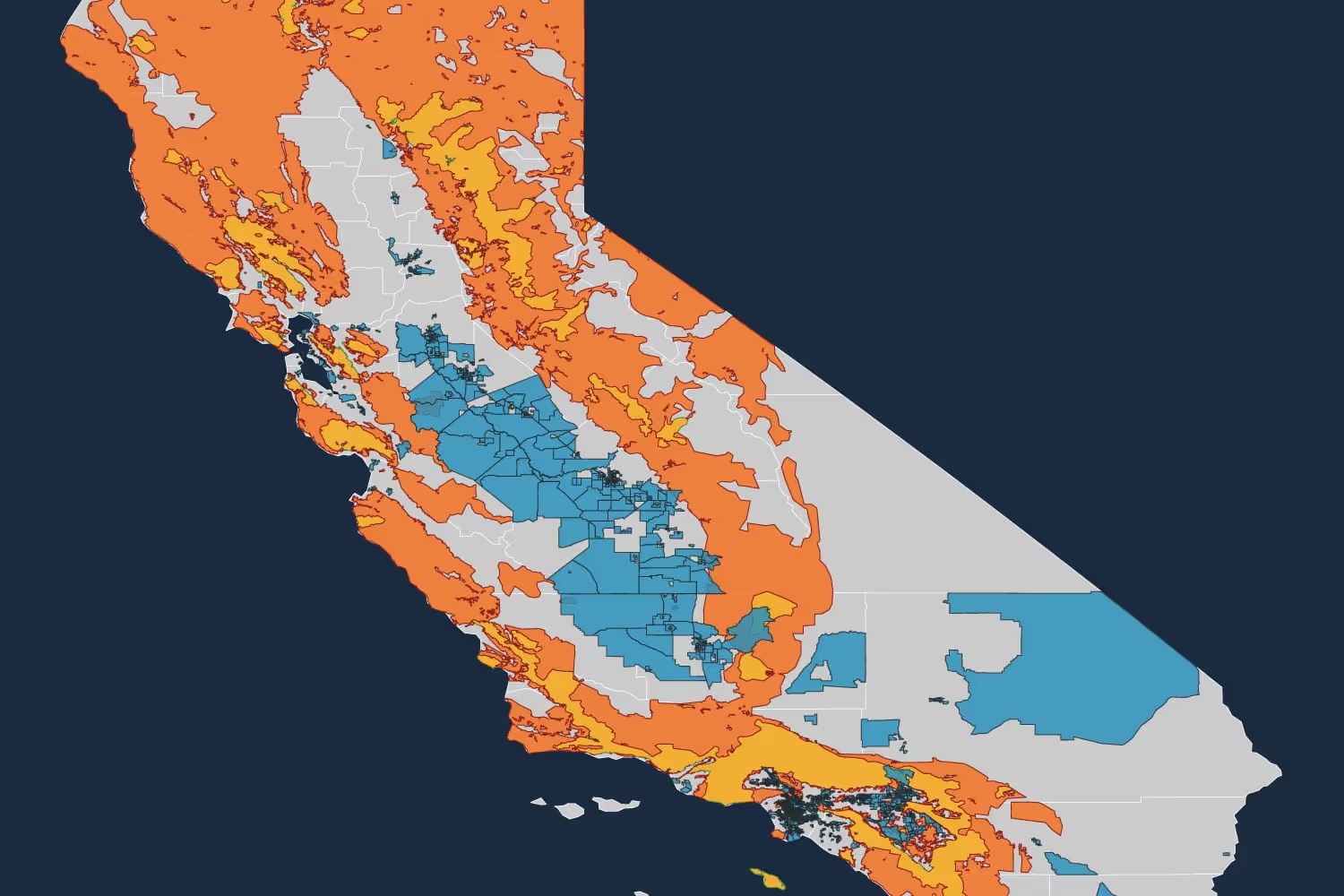
Because the main barrier to this funding is a location within a high-risk area of PSPS, let’s see where that is across the state.
Map: SGIP-Relevant Fire Areas and Disadvantaged Communities
You can make the below map full screen and search property locations to see if they fall within fire threat zones and/or disadvantaged communities.
Equity, Non-Resiliency
Incentive amount: $850/kWh
The naming conventions are confusing so I’m just going to call this Equity, Non-Resiliency. This category essentially reserves SGIP incentives for low-income or disadvantaged communities no matter where they are located. Public agencies in low-income areas are also eligible.
How to qualify for the Equity, Non-Resiliency incentive:
Single family housing must meet one of the following:
- Household income is less than 80% of Area Median Income and house has an affordable housing designation subject to a resale restriction or an equity sharing agreement
- Household income is less than 80% of Area Median Income and house is in a Qualified Census Tract (as designated for the federal Low-Income Housing Tax Credit program), Empowerment Zone, or Enterprise Community
- Customer was previously designated eligible for Single-family Affordable Solar Homes (SASH) program3 Home is owned by a Native American on tribal land
Multifamily housing must meet both of the following criteria:
- Operated to provide deed-restricted low-income residential housing with at least five rental housing units
- Located in a disadvantaged community (DAC), in a low-income community, or on tribal lands (collectively an “SGIP DAC”), or at least 80% of the households have incomes at or below 60% of the area median income. Properties approved in the Solar on Multifamily Affordable Housing (SOMAH) program or the Multifamily Affordable Solar Housing (MASH) program are deemed eligible.
Non-Residential customers:
A government agency, educational institution, non-profit organization, or small business Located in an SGIP DAC 6.
Large-Scale
Incentive amount: $200/kWh (Step 6) and $150/kWh (Step 7) with option for a $150/kWh resiliency adder.
How to qualify for resiliency adder:
Critical facilities in PSP zones that to not serve disadvantaged/low-income communities.
Small Residential General
Incentive Amount: $200/kWh (Step 6) and $150/kWh (Step 7)
How to qualify:
Small residential projects that are not eligible for either the Equity Budget or the Equity Resiliency Budget may take the standard general market incentive. Keep in mind that 50% of the funds in each step are reserved for projects in designated fire zone areas.
Added Resources
There are obviously a lot more details to SGIP eligibility than the discussion in this article. I would encourage you to review the full details using the links below. Shout out to Adam Gerza of Energy Toolbase who helped review the contents of this article!
Read more news and insights from the DG+ team.
.png)


.png)
.avif)
Let’s talk about what you’re building.
Whether you’re refining your positioning, preparing for growth, or trying to make a complex product easier to understand, we’d love to hear more. Share a bit about your goals or challenges and we’ll get back to you with a clear, honest perspective on how we can help.
Skip the form and email us directly at hello@dgplusagency.com