
This article was cross-published by David Ganske on LinkedIn. You can access it directly here.
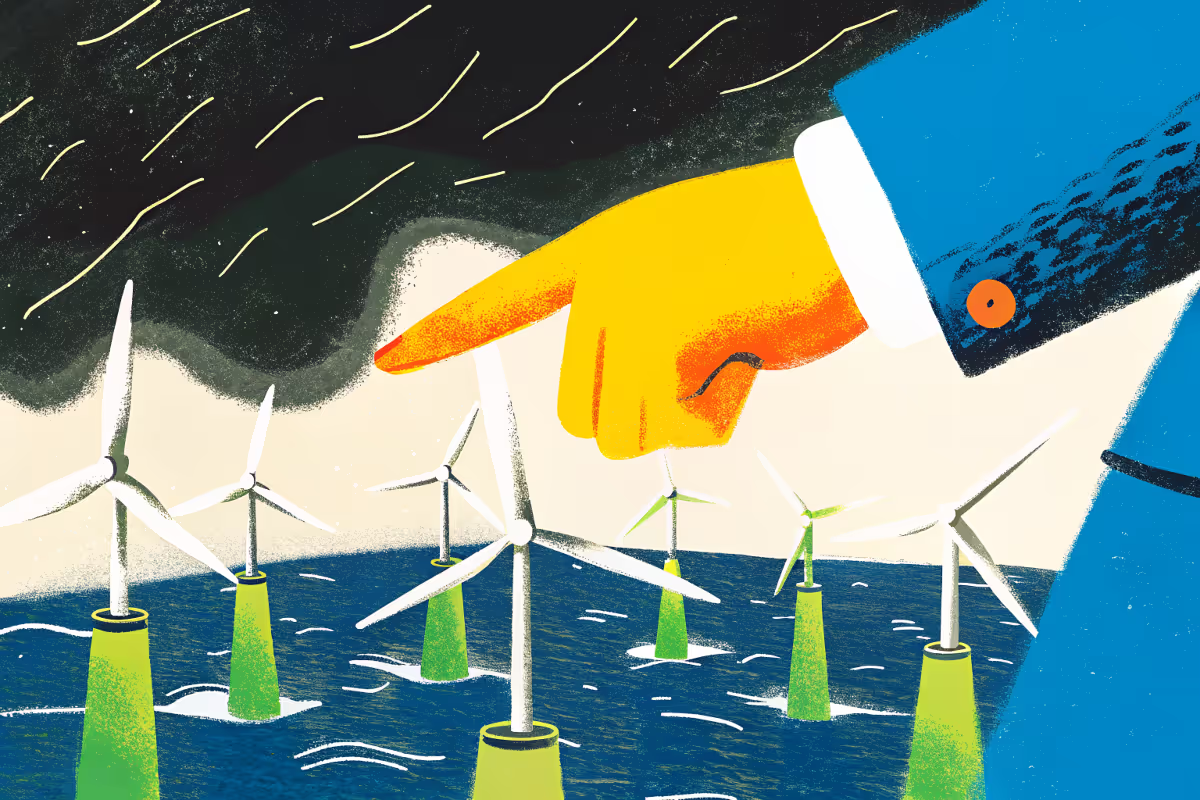
The White House is exploiting a public perception problem that impacts the entire renewable energy sector.
When I was in graduate school over a decade ago, a representative from Deepwater Wind, a Rhode Island offshore wind developer, visited our class to share his vision. He spoke with excitement about deploying turbines up and down North America’s coasts. Several years later, that project — Block Island — became the first commercial offshore wind farm in the United States. At the time, it seemed like the start of something big.
Fast-forward to today, and the outlook feels very different. Offshore wind in the U.S. is on life support. The industry, once seen as a key piece of grid decarbonization and economic growth, is being dismantled in real time. The Trump administration has unraveled over a decade of progress — and in doing so, may have ceded another growing global industry to economic rivals in northern Europe and China.
A wave of cancellations and reversals
The most visible blow just arrived on Friday when Trump halted Ørsted’s Revolution Wind project off Rhode Island at about 80% completion. Forty-five of its 65 turbines are already installed. This is the latest move in a barrage of attacks on the offshore wind energy industry.
On Inauguration Day, the White House issued an executive order that froze all offshore wind activity on the Outer Continental Shelf. The order withdrew every area previously available for offshore leasing and directed federal agencies to revisit the government’s entire approach to leasing and permitting wind projects. In practice, it slammed the brakes on new development and cast doubt on projects that were already underway.

Following the order, the Bureau of Ocean Energy Management (BOEM) rescinded all designated “Wind Energy Areas,” effectively closing off 3.5 million acres of federal waters to new wind development. Interior Secretary Doug Burgum also directed a review of every wind and solar permit on federal lands and waters. In April 2025, Burgum went a step further, moving to block the Empire Wind project off New York’s coast — only for the project to be reinstated the following month after intense legal and political pushback.
These policy reversals don’t just affect individual projects. They inject uncertainty across the entire supply chain. Shipbuilders, cable manufacturers, and port operators that invested billions now face a freeze in activity. Thousands of high-paying union jobs are at risk, and developers have little confidence that projects will survive shifting political winds.
Offshore wind’s perception problem
In truth, offshore wind was vulnerable before Trump’s executive orders. The industry has long battled a perception problem. Opponents have painted turbines as threats to coastal views, fishing industries, and wildlife. That messaging has stuck, and the Trump administration has seized on it to justify dismantling the sector.
Other countries have shown what’s possible when the public is engaged early and consistently. Northern Europe has spent decades normalizing offshore wind as both an economic driver and a climate solution. Denmark even framed wind as part of the country’s national identity as early as the 1990s. China has surged ahead in scaling projects and building a global supply chain. By contrast, in the U.S., efforts at storytelling and education have lagged. Vattenfall’s recent ad campaign featuring Samuel L. Jackson, while clever and overdue, may simply be too late to shift the tide.
In short, wind wasn’t sold as simply a climate solution, it was sold as an economic opportunity that impacted real people in the form of jobs and national pride.

A lesson for renewable energy
Despite the massive potential for American offshore wind that far exceeds the country’s current or projected electricity demand, we have failed to mobilize the public around its benefits.
The irony is that offshore wind had begun to show real momentum. Completed and ongoing projects were contributing to job growth, bipartisan wins, and local economic development. In 2021, the Biden administration set an offshore wind target of 30 GW by 2030, a substantial increase in the pace of offshore wind development. But the past nine months have also been a hard reminder: we should have built public awareness and political resilience much earlier.
I have personally seen (and been a part of) the shift over the past 9 months away from broadcasting climate benefits and relying too heavily on “savings” in messaging. The focus has been on winning the consumer by reducing electricity bills. “Save 10% on your electricity bill by going solar!” or "This project will offset thousands of tons of carbon emissions annually." This messaging clearly worked to grow the industry to where it is today, but we should have gone broader sooner by incorporating jobs, resilience, American competitiveness, and other themes decades ago instead of just over the last nine months.
We also should have done more earlier to reduce NIMBYism through broader public awareness campaigns. The “not in my backyard” threat is real for offshore wind close to shore, just as it is for onshore solar and wind projects. Major projects, including the Morro Bay Wind Energy Area in California, Vineyard Wind, and others faced serious opposition from local communities. Concerns vary from impacting fisheries and bird migration to being an eyesore on the coastline. However, the economic and clean power benefits vastly outweigh what some see as a negative visual.
The lesson is that renewable energy advocates should be treating community engagement and public education as core infrastructure — not afterthoughts. If the industry doesn’t win hearts and minds before turbines (or modules) go up, it risks being undone by the next wave of political backlash. Offshore wind is only the latest example.
Looking ahead
Despite the grim outlook, I remain convinced that offshore wind must play a role in America’s long-term energy strategy. The technical potential is staggering: thousands of gigawatts of clean electricity, enough to power tens of millions of homes.
Offshore wind can also support electrification of transport, manufacturing, and data centers, all of which are driving surging demand. This is especially true as electricity demand continues booming over the next 10 years and new capacity to meet this demand is limited. Transport electrification, a growing manufacturing sector, and the rise of data centers to fuel generative AI are adding new loads to the grid — all desperately need clean energy.
For example, Forum Mobility’s new charging depot for heavy-duty electric trucks that broke ground in May 2024 has a power demand of 9 MW for a single site. Data centers in the U.S. consumed 150 terawatt-hours in 2023, or the equivalent of the average annual consumption of 14 million households.
But we are now watching the U.S. willingly surrender this opportunity. Instead of building a world-class domestic industry, we are creating space for rivals abroad to dominate. And that should serve as a sobering lesson for the broader clean energy transition.
Is this the end of offshore wind in the U.S.? Unless public awareness campaigns grow stronger — and unless a future administration reverses course quickly — the answer may well be yes.
Read more news and insights from the DG+ team.
.png)

.png)
.avif)
Let’s talk about what you’re building.
Whether you’re refining your positioning, preparing for growth, or trying to make a complex product easier to understand, we’d love to hear more. Share a bit about your goals or challenges and we’ll get back to you with a clear, honest perspective on how we can help.
Skip the form and email us directly at hello@dgplusagency.com