

Around the world, people and companies are mobilizing in the fight against climate change. It’s all hands on deck, and that’s good news for the future. But it also means that any company offering sustainable products or services – from renewable energy, to regenerative agriculture, to water conservation – faces intense competition. To survive and thrive in the market today, businesses need to have a deep understanding of their competitive landscape. That is where competitive analysis comes in.
Competitive analysis is the process of researching competitors to understand their products, sales, marketing tactics, and customer base to inform your company’s operations and marketing strategy. In this article, we show the value – both broad and specific – that competitive analysis can give your business, and explain some of the most commonly used frameworks for conducting it.
The Benefits of Competitive Analysis
A competitive analysis can be a treasure trove if conducted systematically and methodically. At a broad level, it can show you the structure of your industry and the forces shaping it. How many new market entrants have there been in recent years? Are there any mergers shaking up the industry? What’s the cutting edge technology in your industry? Whereas industry news reports can often give partial or skewed information, a data-driven competitive analysis provides your company with a comprehensive picture of your industry, identifies the interactions between different factors that impact the market, and allows your business to stay ahead of market trends.
On a more micro level, a competitive analysis holds a magnifying glass over each of your competitors to answer more precise questions. For example: What are your competitors doing right? Where are they missing the mark? What do they offer? What do their customers think of them? With this, you can then fine-tune your business’s differentiators, stay relevant to your customers, and craft a benchmark to track your progress.
Once you decide to analyze your competition, where do you begin? There are a variety of approaches, and your business’ goals should inform which strategy you adopt.
Porter’s Five Forces
Arguably the most influential competitive analysis approach is the Five Forces framework, developed by renowned Harvard Business School professor Michael E. Porter. Porter’s Five Forces framework invites us to adopt a holistic view of an industry by analyzing the five primary forces that shape an industry’s competitive landscape
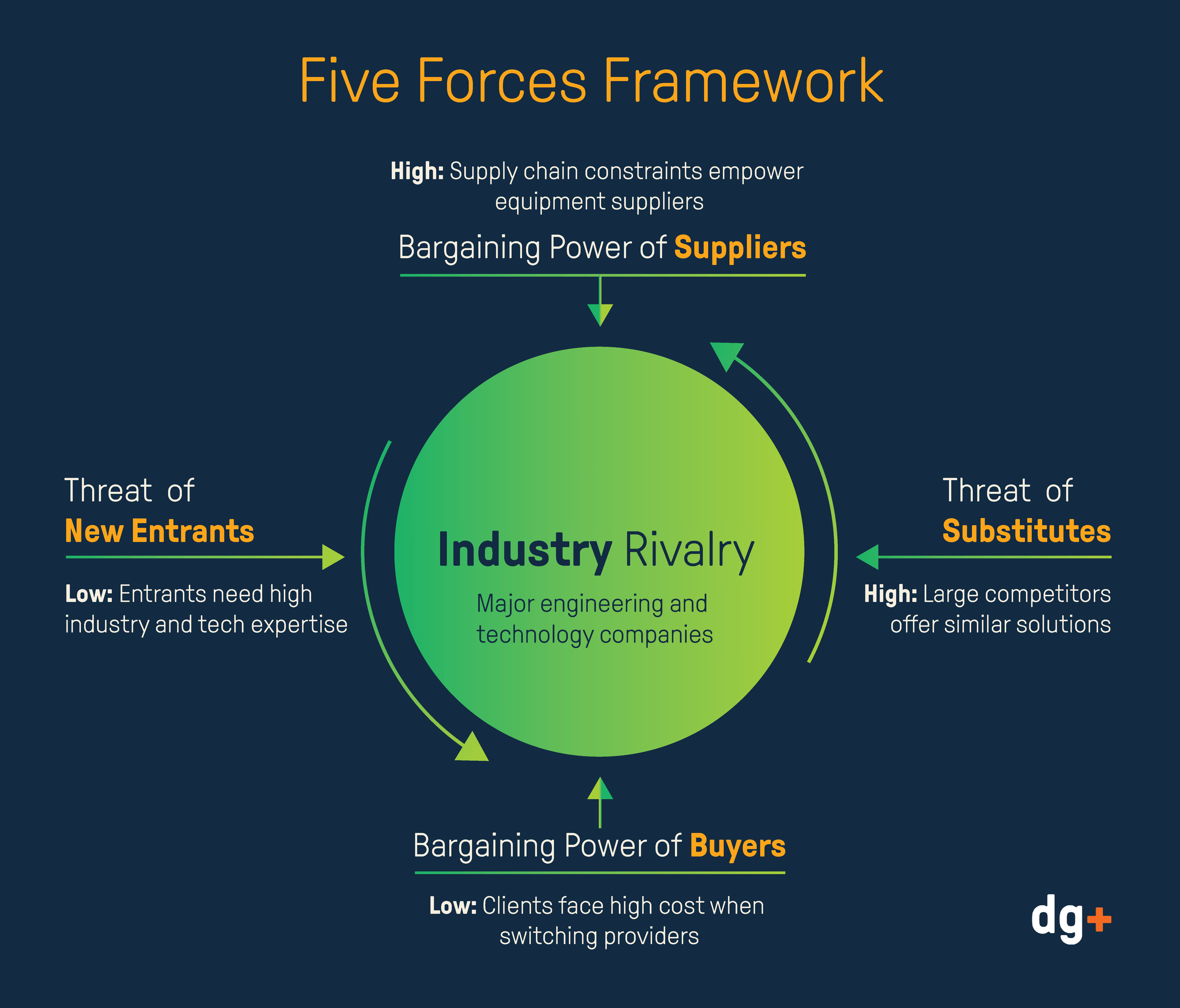
Porter’s Five Forces are:
- Industry rivalry. Identify your immediate competitors and the threat they pose to your business. Analyze their products or services, business models, target customer base, brand marketing, and more. The more competitors there are, the more intense the rivalry, therefore the greater the need for you to know the ins and outs of your competitors’ strategies.
- Threat of new entrants. Assess your market’s barriers to entry. Can newcomers easily break into your market? If the answer is yes, then your business’s market share, revenue, and customer base are potentially vulnerable to new entrants. In contrast, higher barriers to entry can strengthen your market position and power.
- Bargaining power of suppliers. Understanding your supply chain helps your business create a clearer roadmap for future operations. Can suppliers easily raise prices? What would it cost for you to switch suppliers? The fewer suppliers there are in your industry, the more your company is exposed to price changes, supply shortages, and other forces that can significantly impact your bottom line.
- Bargaining power of buyers. Assess your buyers or customers: How large are your target segments? How much would it cost to find a new customer base? Smaller groups of buyers have a stronger influence over market pricing, especially in an industry where it’s difficult to obtain new customers.
- Threat of substitutes. Closely analyze your industry for competing products and services to assess exactly how much freedom you have over your offerings. If you produce goods or services that don’t have close substitutes, then you have more power to change prices and increase market share.
Let’s say you’re a cleantech startup that offers sensors and software to help water utilities measure and conserve water. As the need to efficiently manage water becomes more urgent, the smart water solutions industry becomes more competitive. You’ll be jostling with many major engineering and technology companies that offer competing water management solutions. At the same time, the barriers to entry are fairly high, since breaking into this space requires engineering chops, expertise in the Internet of Things, and detailed knowledge of water and wastewater business models. This means that despite intense competition, the threat of new entrants is relatively low, so your business can focus on the players currently dominating the market.
While the threat of substitute products and services from your large competitors are high, it’s not easy for your existing clients to switch over to another provider because of the extensive consultation process to tailor a water management solution. This tells you that as long as your company maintains its unique edge over your competitors (such as lower prices, responsive and helpful customer service, etc.), your clients are more likely to stay with you.
As for the bargaining power of suppliers, recent constraints on semiconductor supply chains have made it harder for you to quickly deploy sensor equipment. You should map out exit options by identifying other suppliers for your equipment in case your existing resources encounter bottlenecks or delays.
SWOT Analysis
Using Porter’s Five Forces will give you a bird’s-eye view of your industry. A SWOT (Strengths, Weaknesses, Opportunities, and Threats) Analysis enables you to zoom into the capabilities of your own business and how it fits into the broader competitive environment.
Strengths. Pinpoint what your company excels at over your competition: a strong brand, loyal customer base, a strong balance sheet, unique technology. Maintain and strengthen this advantage.
Weaknesses. Conversely, what areas of your business need improvement? These can be products, services, marketing and communications strategies, or even organizational structure and workflows. Once you do, you can strategize how to improve those areas.
Opportunities. What external factors give you a competitive advantage? This could be anything from the competitive landscape identified by Porter, what’s trending in the news, the tax environment, to broader macroeconomic shifts. There are nearly infinite ways to capitalize on these opportunities.
Threats. What are the external factors that can harm you? Extreme weather events that bump up the costs for materials, tight labor market, bad press, increasing competition can all pose threats. Once you identify these risks, you can craft tactics to protect against them or turn them into opportunities.
Back to our example of the water management startup: Many of the components in the SWOT analysis can be taken from Porter’s Five Forces, such as increased awareness of the need for water conservation as an Opportunity and the existence of large competitors and a tight labor market as Threats. Analyzing your Strengths and Weaknesses will give you insights into your company’s internal operations. Maybe your small but cohesive and dynamic team is your greatest asset, while loyal clients and affordable prices give you an edge over your competitors. Implications here could mean to keep prices lower than your competitors and focus on your existing customers.
As for your Weaknesses, maybe you haven’t had the time or resources to implement a great marketing strategy yet, limiting your exposure to potential clients. Perhaps your ability to take on new clients is limited because of your small team. Again, this analysis can point you in an actionable direction. For example, consider hiring or contracting with a dedicated marketing team to heighten your company’s visibility.
Informing Strategy with Competitive Analysis
Taking these insights together can inform a superior competitive strategy. Porter’s Five Forces allow you to see the competitive landscape in your industry holistically, taking into consideration the threats that not only your immediate competitors, but also your buyers, suppliers, and potential new entrants pose on your business. SWOT analysis lets you identify what your strengths are that you need to maintain, and what weaknesses you should improve on to become more competitive.
Want to start in-depth and comprehensive competitive analysis to inform your strategy? DG+ can help. Reach out to let us know what type of market research you’re looking for.
Read more news and insights from the DG+ team.
.png)



.png)
.avif)
Let’s talk about what you’re building.
Whether you’re refining your positioning, preparing for growth, or trying to make a complex product easier to understand, we’d love to hear more. Share a bit about your goals or challenges and we’ll get back to you with a clear, honest perspective on how we can help.
Skip the form and email us directly at hello@dgplusagency.com