
Developers can leverage strategy and marketing to position themselves to secure project financing from this historic fund.
As part of the Biden Administration’s landmark Inflation Reduction Act (IRA), which opened up $369 billion in climate capital, the Environmental Protection Agency (EPA) was authorized to administer the Greenhouse Gas Reduction Fund, or GGRF. The GGRF comprises three sub-funds: the National Clean Investment Fund (NCIF), the Clean Communities Investment Accelerator (CCIA), and Solar for All. Totalling $27 billion, the GGRF aims to provide capital to finance renewable energy and sustainable infrastructure projects to lower emissions. A major focus of the program is on low-income and disadvantaged communities (LIDACs), which have been historically left out of the decarbonization conversation.
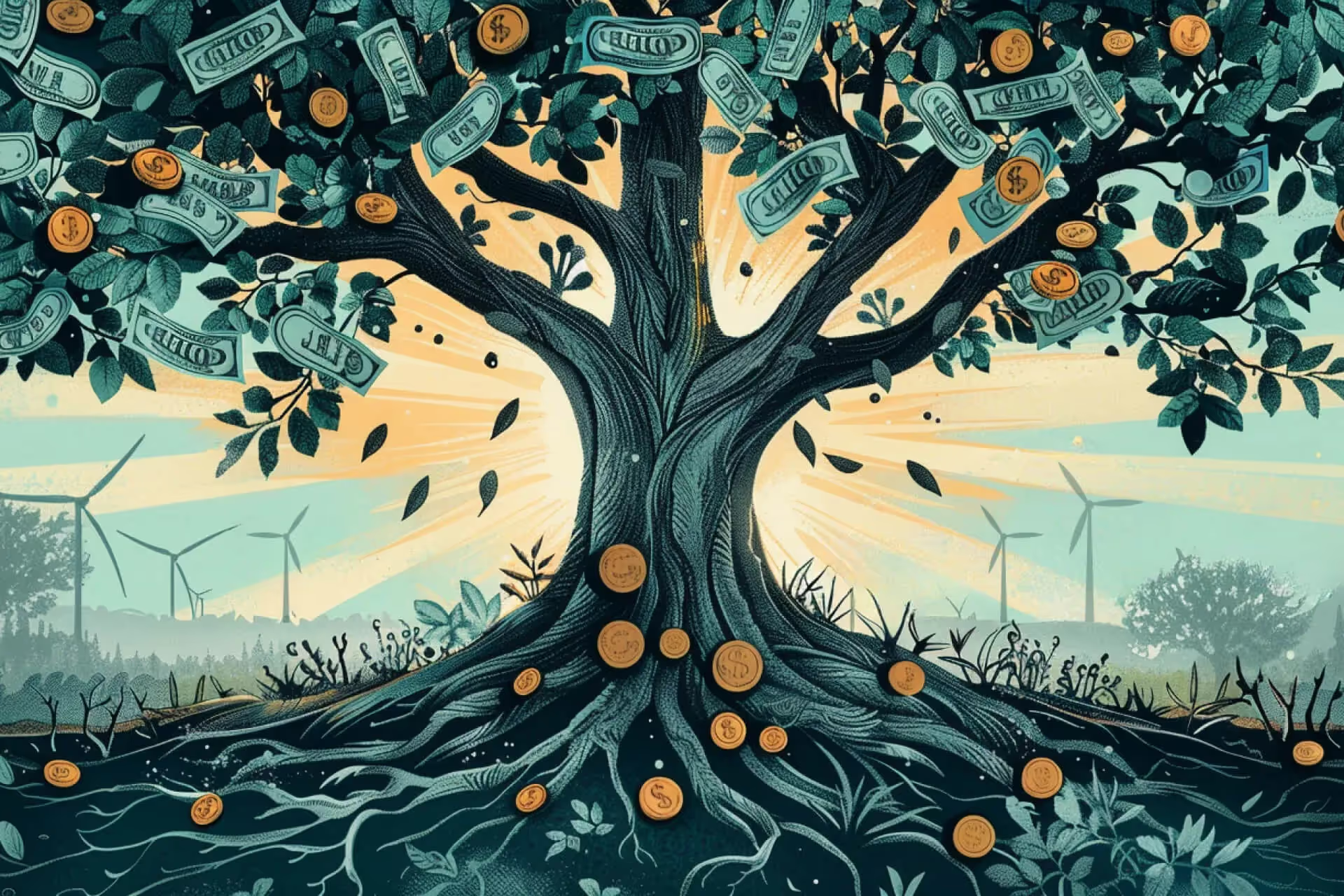
The GGRF is designed to attract private investment in sustainable infrastructure. Think of it as a seed that grows a tree, with private investment acting as the water or sunlight that nourishes it. While the seeds (GGRF funds) will grow into trees on their own, they will eventually dry up without water to feed them. However, by planting the seed and feeding the “tree” with private investment, the GGRF creates a sustainable cycle that produces more capital over time. Simply put, the GGRF aims to catalyze ongoing investment in sustainable infrastructure by leveraging public funds to attract private capital.
On April 4th, the Biden Administration announced the awardees of the NCIF and CCIA funds, which account for $20 billion of the GGRF. Distributed amongst eight applicants, the funding will “create a first-of-its-kind national network of mission-driven, community-led financial institutions'' with the goal of supporting sustainable infrastructure developments in LIDACs across the US. While the two funds share a broad goal of directing capital to sustainable infrastructure, with at least 70% of the money going to LIDACs, each winning organization varies in its own mission and will delegate its funding towards the achievement of its goals.
However, securing that funding will require strategic marketing and positioning. In an industry as exciting and dense as sustainable infrastructure, it will be crucial for developers looking to partner with GGRF-backed investors to differentiate themselves from the competition and align their identity with the goals of both the investor and the GGRF more broadly.
Breaking down the GGRF
The GGRF is made up of three smaller funding streams, each with their own focus:
- The National Clean Investment Fund (NCIF), a $14-billion “national green bank” that will capitalize two to three clean financing institutions. These institutions will work with the private sector to spur investments in clean energy, emission-free transportation, and net-zero building projects.
- The Clean Communities Investment Accelerator (CCIA), a $6-billion fund that will award grants to two to seven hub nonprofits responsible for providing community lenders — such as CDFIs, credit unions and green banks — with funding and technical support for sustainable infrastructure projects, namely in LIDACs.
- Solar for All, a $7-billion grant program that will award up to 60 grants to state, local, territorial and Tribal governments, as well as nonprofits, to support the adoption of small-scale clean energy systems involving solar and battery storage in disadvantaged and LIDACs.
Key awardees
For developers, each of these funds offer unique and exciting opportunities for financing, depending on the project. Whether you work in renewable energy, energy efficiency, electric vehicles, or other climate tech spaces, investors with GGRF monies could inject your projects with incredible funding.
With that in mind, developers should pay close attention to the specific missions of whichever organization they hope to partner with. Winners under the NCIF will partner with private sector players and community organizations to provide financing for renewable energy projects in LIDACs. The NCIF was awarded to three organizations: Climate United Fund, Coalition for Green Capital, and Power Forward Communities.
The Awardees
Climate United Fund
Climate United Fund aims to invest in smaller market segments like consumers, small businesses, small farms, community facilities, and schools. The Fund has an ambitious social goal of investing at least 60% of its award in LIDACs, 20% in rural communities, and 10% in Tribal communities.
Coalition for Green Capital
The Coalition for Green Capital (CGC) will emphasize public-private investing by leveraging the existing and growing national network of green banks. CGC has a goal of investing at least 50% of its award in LIDACs.
Power Forward Communities
Power Forward Communities is a coalition of Enterprise Community Partners, LISC (Local Initiatives Support Corporation), Rewiring America, Habitat for Humanity, and United Way. They will operate a national financing program to provide customized and affordable solutions for single-family and multi-family housing owners and developers. At least 75% of their investments will be made in LIDACs.
Differentiation
Given how specialized each awardee is, developers looking to partner with GGRF awardees will need to differentiate themselves from the competition and demonstrate their alignment with the awardees’ — and the fund’s — goals. This includes its emphasis on LIDACs, so aligning your firm with an ethos of equity and a dedication to environmental justice will be paramount to identifying yourself as a partner worth investing in. That can be achieved in a variety of ways, but regardless of how your firm hopes to distinguish itself, it will need to take strategic steps and leverage effective marketing to do so.
Tips to get GGRF funding
Enter the pipeline
Now that the GGRF has been announced and the awardees have been selected, the time has come for developers to enter the financing pipeline. Begin reaching out to awarded organizations as soon as possible to extend congratulations, muse on the future, and present your case for partnership on shovel-ready projects. The money will soon be out there, as awardees will have their funding in their pockets as early as this summer, and will be eager to fuse it with private capital to distribute it. You need to demonstrate to these investment groups that your firm is aligned with their goals, capable of delivering successful projects at scale, and reliable as a partner.
Build relationships
Although the GGRF requires at least 40% of the NCIF funding to go to LIDACs, every selected applicant surpassed that amount. Because of this, about 60% of the NCIF funding will go to these communities. In addition, 100% of the CCIA funding will go to LIDACs. Because of this emphasis on building projects in these communities, developers should focus on building relationships with organizations and nonprofits that work within them. Aligning across missions and establishing rapport will help your firm make the short list and stay top of mind when the time comes to partner with a developer.
Are you qualified?
Once the funding is distributed, recipients are responsible for investing in projects related to clean energy, zero-emission transportation, and net-zero buildings. This could mean projects like community solar arrays, EV charging infrastructure, or energy-efficiency upgrades for buildings.
The EPA’s Notice of Funding Opportunity defines a qualified project as any project, activity, or technology that does one of the following:
- Reduces or avoids greenhouse gas emissions and other forms of air pollution in partnership with, and by leveraging investment from, the private sector
- Assists communities in their efforts to reduce or avoid greenhouse gas emissions and other forms of air pollution
This could mean projects like a community solar program bringing clean power to renters in a multi-family building, an EV charging station allowing drivers to power up in a low-income area, or a series of energy-efficiency upgrades for an aging apartment complex.

Each project must also mobilize private capital, demonstrate that it wouldn’t have happened without GGRF support, and provide additional benefits such as clean energy, affordable housing, or the cleanup of legacy pollution.
Demonstrate success
$20 billion is a lot of money - and investors will not want to see it wasted. Developers looking to secure financing for their projects should be able to demonstrate successful completion of previous projects. The GGRF is not a pilot project fund — it is an injection of capital for proven technologies that can scale and make serious emissions reductions. Preparing a list of projects, elevating your portfolio, and presenting it as effectively as possible will be crucial in the pursuit of partnership with GGRF awardees.
Conclusion
The race is on: $20 billion across a slew of ambitious organizations will soon begin pouring into the renewable energy and sustainability market, with a special emphasis on low-income and disadvantaged communities. For developers looking to expand their reach, grow their portfolio, and contribute to solving the greatest challenge of our time, the GGRF presents a massive opportunity.
However, in order to distinguish themselves as valuable partners and secure financing from this historic fund, they will have to implement effective marketing strategies to position themselves as leaders in this crowded space. From messaging, to branding, to marketing campaigns, the identity developers build for themselves will determine whether or not they are called upon by these eight awardees as part of the NCIF and CCIA.
Biden’s IRA has catalyzed a new era of growth in the renewable energy industry, and the GGRF is the latest example of that. If you are wondering how effective marketing powered by renewable energy insight can elevate your company above the competition, reach out to DG+ today.
Awardees Index
*Organization missions from whitehouse.gov
Read more news and insights from the DG+ team.
.png)


.png)
.avif)
Let’s talk about what you’re building.
Whether you’re refining your positioning, preparing for growth, or trying to make a complex product easier to understand, we’d love to hear more. Share a bit about your goals or challenges and we’ll get back to you with a clear, honest perspective on how we can help.
Skip the form and email us directly at hello@dgplusagency.com