
In order to meet critical climate goals, humanity must reduce its global carbon footprint by rapidly transitioning from its reliance on fossil fuels to new renewable energy technologies. Alternative fuels will play a huge role in this transition, and perhaps the most important of these is hydrogen. Hydrogen is, and will be, especially critical in sectors where other alternative fuel sources like solar and wind can not provide support.
As a fuel, hydrogen holds massive potential across power, transportation, and many industries, because it is a clean-burning, highly flexible fuel whose only byproduct is water. However, the vast majority of hydrogen production is a huge source of carbon emissions in itself because it is produced with polluting fossil fuels. Currently, less than 1% of global hydrogen production is low-emission hydrogen. “Low-emission” means that the hydrogen is either produced via some sort of electrolysis, or through coal, gas, or oil gasification with carbon-capture, utilization, and storage. For hydrogen to be a truly clean fuel source, production facilities must transition entirely to renewable energy sources to produce what is called “green” hydrogen.
From Gray To Green: The Hydrogen Color Spectrum
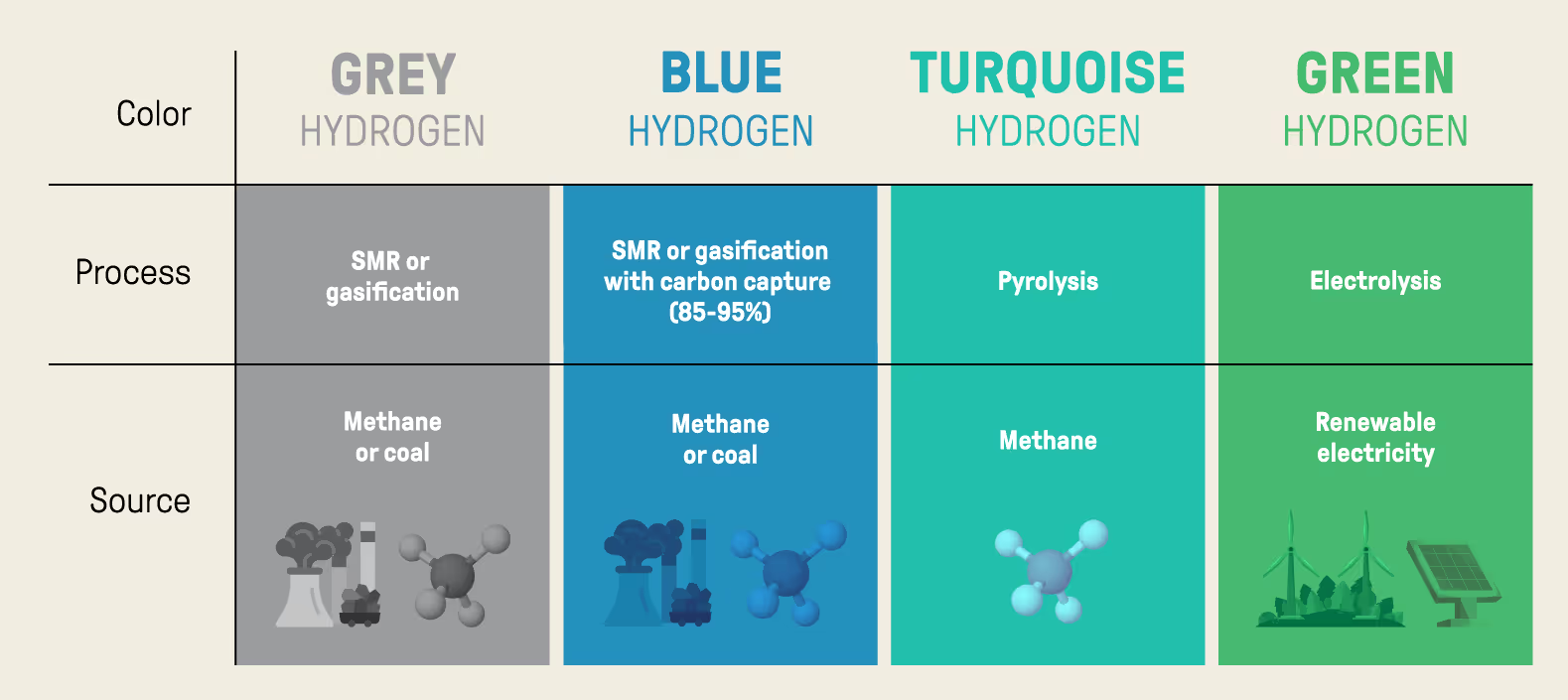
The production of hydrogen requires a great deal of energy. The source of that energy is what determines where the hydrogen end product falls on what is called the hydrogen color spectrum. Among others, the hydrogen color spectrum includes the aforementioned green hydrogen, as well as “blue,” “pink,” and “gray” hydrogen.
Today, more than 95% of hydrogen is produced from unabated fossil fuel steam reformation, which requires the burning of natural gas and coal - this is known as gray hydrogen. Because of its carbon-intensive methods, gray hydrogen production contributed more than 900 megatons of CO2 in 2021. What this means is that within its life cycle, gray hydrogen production is entirely counterproductive to global climate goals.
World Economic Forum
“Blue” hydrogen, which is carbon-based, is produced from fossil fuels in facilities with carbon-capture technology. These are cleaner than gray hydrogen production methods, but still not clean enough for a sustainable future.
“Turquoise” hydrogen, an emerging technology, is produced via methane pyrolysis, which is the thermal breakdown of methane gas into hydrogen and solid carbon.
“Pink” hydrogen, which is not mentioned in the graphic above (but is included in our analysis of the IEA dataset), is hydrogen produced through electrolysis with nuclear energy.
In order to make hydrogen a fully emissionless fuel and meet the Net Zero by 2050 timeline, green electrolysis production methods must comprise more of the global hydrogen supply. While blue and other low-emission hydrogen may be helpful in transition, the end goal should be emissionless, green hydrogen. Luckily, green hydrogen has momentum.
The IEA Hydrogen Projects Database
To understand what the pace of this technological transition has been in the past 20 years, specifically the fruition of dedicated renewable energy hydrogen production, the DG+ market research team analyzed data from the IEA’s Hydrogen Projects Database. This database includes data on all low-emission (green, blue, and pink) hydrogen projects commissioned globally since 2000 for energy or climate change mitigation purposes, including production technologies, end uses, and capacity.
In particular, we analyzed the growing number of hydrogen production facilities over time based on both end use and production method. We posit that the number of facilities is a better indicator of market momentum than facility size, because individual facilities vary greatly in capacity, which can skew analysis. This is demonstrated by Paraguay, which has the third greatest hydrogen capacity in the dataset with only one production facility in the country.
DG+ found that global low-emission hydrogen production has been heavily trending towards end uses in transportation, power generation, and as a supplemental gas in grid pipelines. In addition, green hydrogen has seen accelerated growth in recent years due to falling costs and technological advancements.
*Production method counts do not sum to 400 because of how the data was constructed in the IEA dataset. Certain hydrogen production facilities were missing production method information, so some facilities were not counted.
The proportion of hydrogen produced with renewable energy technology has steadily increased for the past 10 years, with especially fast growth seen in the past two years, as the number of facilities increased from 95 to 156. Although the low-emission production of hydrogen accounts for less than 1% of global hydrogen production, it’s evident above that advancements in renewable energy technologies have given green hydrogen strong momentum. It's important to note that while grid-powered electrolysis could feasibly be considered low-emissions, it is difficult to guarantee this while much of global grid power still comes from carbon-based sources. As it currently makes up the third largest portion of low-emissions hydrogen generation in the IEA dataset, it is even more crucial to accelerate global investment in utility-scale renewable energy.
More and more renewable energy resources have been dedicated to the production of green hydrogen electrolysis, driven largely by falling costs of renewable energy development. Additionally, the cost of electrolysis equipment has steadily declined, while its efficiency has continued to improve. Current projections predict that low-emission hydrogen production will reach cost-competitiveness at $2 per kilogram shortly after 2030, which would further stimulate the clean hydrogen market.
End Uses Of Low-Emission Hydrogen Are Expanding
Hydrogen has applications in many industries, ranging from domestic heat to fertilizer to combined heat and power (CHP). However, most unabated hydrogen production - almost 94 megatons - is dedicated to the chemical and petrochemical sectors. Three main end uses account for most of the global low-emission hydrogen demand: transportation, power generation, and grid injection, which includes both hydrogen and synthetic methane as a grid-injected natural gas.
For our analysis, “Transportation” included the end uses of hydrogen as a transportation fuel (vehicular, rail, maritime, and aviation fuel), synthetic methane as a fuel, and other synthetic fuels. “Other Industry” included industries such as ammonia and methanol production. The growth of these low-emissions projects by end use is presented here:
*End use counts are inflated because of how the data was constructed in the IEA dataset. Certain hydrogen production facilities had multiple end uses, so they were counted twice. Globally, there were actually a total of 401 low-emission hydrogen production facilities in the IEA dataset. Of the 353 low-emission hydrogen production facilities with end use data, 83 had more than one end use, for a total of 467 end uses.
In the past 20 years, the number of low-emission hydrogen production facilities has skyrocketed from less than 10 facilities to over 400 worldwide. Hydrogen production for the end use as a transportation fuel has seen a particularly accelerated ascent as global emphasis on the decarbonization of the transportation sector has grown. The global transportation sector accounted for 37% of CO2 emissions in 2021, making alternative fuel vehicles like hydrogen fuel cell automobiles and hydrogen-powered airplanes impactful technologies in the decarbonization of the transportation industry. In fact, a growing number of countries around the world are incorporating low-emission vehicles into their emissions reductions strategies.
In addition to this, global power generation (including both electricity and heat) emissions topped 14 gigatons of CO2 in 2021. Decarbonizing the energy sector will require the rapid deployment of low-emission hydrogen production facilities. Importantly, there is progress being made. Compared to transportation, there were nearly twice as many low-emission hydrogen production facilities for the end use of power generation worldwide in 2011; and although transportation has now outpaced power, the number of low-emission hydrogen facilities for power generation has grown from 45 to 119. This global trend of growth in both power and transportation is driven in large part by five nations (Germany, USA, China, Japan, and France), which account for almost half of the low-emission hydrogen production facilities in the world.
Germany Is A Leader In Low-Emission Hydrogen Production
The leading nation in hydrogen production is Germany, which houses 60 facilities within its borders - about 15% of the global number of facilities. Since the turn of the century, the end use of Germany’s produced hydrogen has remained relatively evenly spread across the three global focal end uses discussed earlier - power generation, transportation fuel, and as grid-injected natural gas. Interestingly, their individual growth rates have kept pace with each other, likely because of Germany’s strong policy support for hydrogen, and less a result of market forces.
Germany’s Hydrogen Industrial Strategy lays out a framework for the country’s continued transition from coal dependence to alternative fuels. Its strategy is based largely on achieving climate goals, which includes earmarking $8.1 billion for hydrogen technology development, and calling for an urgent decision on whether to continue investing in blue hydrogen as a bridging technology. While blue hydrogen is seen as a sustainable fuel source by many today, the end goal must be to transition entirely to completely green hydrogen.
*End use counts are inflated, because of how the data was constructed in the IEA dataset. Certain hydrogen production facilities had multiple end uses, so in some cases, facilities were counted twice. Germany actually had 60 individual hydrogen production facilities in the IEA dataset. Of the 59 facilities with end use data, 20 had more than one end use, for a total of 91 end uses.
The trends seen above are in line with hydrogen end use trends globally. In other leading countries like the USA, China, and Japan, low-emission hydrogen is increasingly being utilized for end uses in transportation and power generation.
More Work Must Be Done
The global potential of low-carbon hydrogen production is massive, and it is already being leveraged as an alternative fuel today. With applications across the industry, transportation, and power sectors, implementing this fuel technology will be a crucial part of the global transition away from fossil fuels, because of its emissionless combustion and wide-ranging usability.
However, in order to incorporate truly green hydrogen into the global energy supply chain, there will need to be massive investments made in the expansion of dedicated renewable energy production, and the inclusion of carbon-capture technology into fossil fuel-based production. As we’ve seen in Germany, top-down policy can play a huge role in incentivizing progress. National policymakers must prioritize green hydrogen as a clean energy vector, like many already have.
The growth of green hydrogen has momentum, and as electrolysis technology and renewable energy costs continue to fall, this industry looks positioned to grow. However, there is plenty of work to be done if humanity is to meet Net Zero by 2050.
Wondering how data analysis and market insight can support your marketing efforts? Reach out to the market research team at DG+ for more information on how you can leverage data for decision-making and more.
Read more news and insights from the DG+ team.
.png)



.png)
.avif)
Let’s talk about what you’re building.
Whether you’re refining your positioning, preparing for growth, or trying to make a complex product easier to understand, we’d love to hear more. Share a bit about your goals or challenges and we’ll get back to you with a clear, honest perspective on how we can help.
Skip the form and email us directly at hello@dgplusagency.com