Report
U.S. EV Policy Report
The DG+ U.S. EV Policy Report takes a look at federal, state, and regional-level policy initiatives that impact electric vehicle (EV) accessibility across the country.
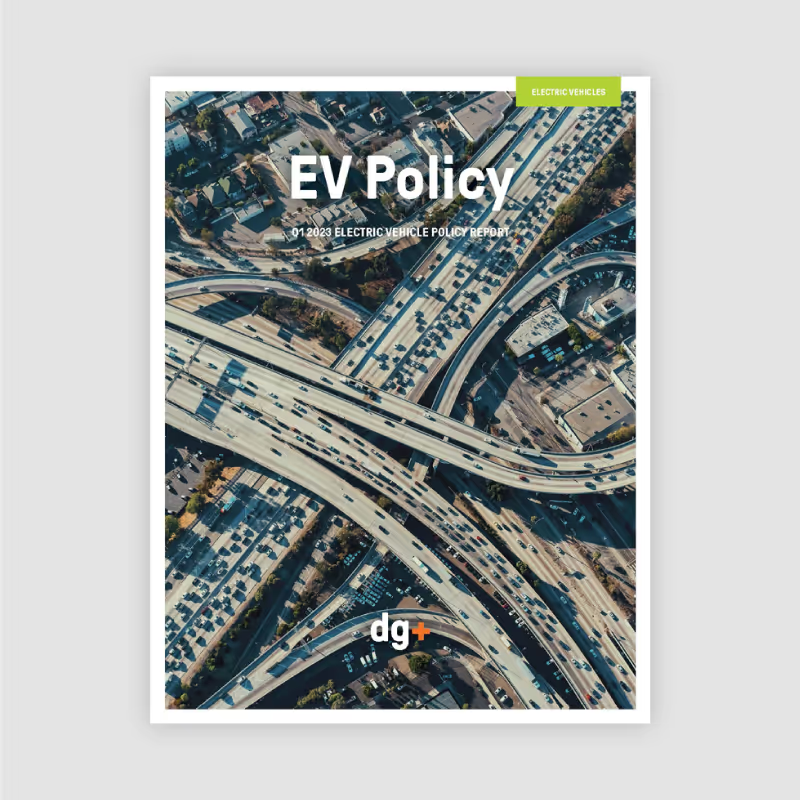
Through regional, state, and federal initiatives, EV ownership is becoming more and more economical for everyday people.
On a national scale, the driving force behind electric vehicle (EV) adoption continues to be the federal $7,500 rebate for the purchase of a qualifying plug-in EV. Thanks to the Inflation Reduction Act, the rebate was extended and certain manufacturer production caps were eliminated, although only vehicles with final assembly in North America qualify. This, in tandem with the National Electric Vehicle Infrastructure funding from the Bipartisan Infrastructure Law, have earmarked nearly $100 billion for EVs and EV infrastructure across the country. All of this funding is aimed at resolving the double-edged issue facing EV adoption in the US: Why should people purchase an EV when the infrastructure isn’t there? And why should a national charging network be developed when so few people own EVs?
The general state-based strategy remains to be offering EV and electric vehicle supply equipment (EVSE) rebates, direct grants, and other tax incentives. Some states take things a step further, offering additional perks like HOV lane exemptions. This Q1 2023 report dives headfirst into which states are offering incentives, what their value is, and other EV bonuses that can be found across the country. In a weighted assessment of all 50 states, DG+ evaluated the incentives above, EV registrations by state, the availability of EV chargers, retail electricity prices, and total state NEVI funding to present the DG+ State Scorecard, ranking all 50 states in terms of EV favorability through both policy and economic drivers. Coming out on top this time: New Jersey, followed by California and Oregon.
The report also includes a total cost of ownership (TCO) model over five years for owning an EV versus an internal combustion engine (ICE) vehicle. The model compares analogous models, pitting the Ford F-150 SuperCrew against the F-150 Lightning EV SuperCrew. According to DG+’s TCO model, owning an EV is cheaper than an ICE vehicle in every state in the nation, with monthly savings ranging from $51 in Alaska, to $239 in Oregon.
On a broader scale, this report discusses the historic amount of funding dedicated towards EV infrastructure development and incentives. Federal investments come mostly from last year’s Bipartisan Infrastructure Law and its NEVI program, and the recently-signed Inflation Reduction Act, as well as continued Department of Energy allocations. Despite all this funding, residential areas are typically underinvested in for EV accessibility, especially in low-income communities, which will be of utmost importance moving forward, if the US hopes to create an equitable transition to EVs. Although the U.S. has a long way to go to make owning an EV the norm for all communities, this report describes the immense progress being made.
Download today for free!

More Insightful resources from our library



Let’s talk about what you’re building.
Whether you’re refining your positioning, preparing for growth, or trying to make a complex product easier to understand, we’d love to hear more. Share a bit about your goals or challenges and we’ll get back to you with a clear, honest perspective on how we can help.
Skip the form and email us directly at hello@dgplusagency.com